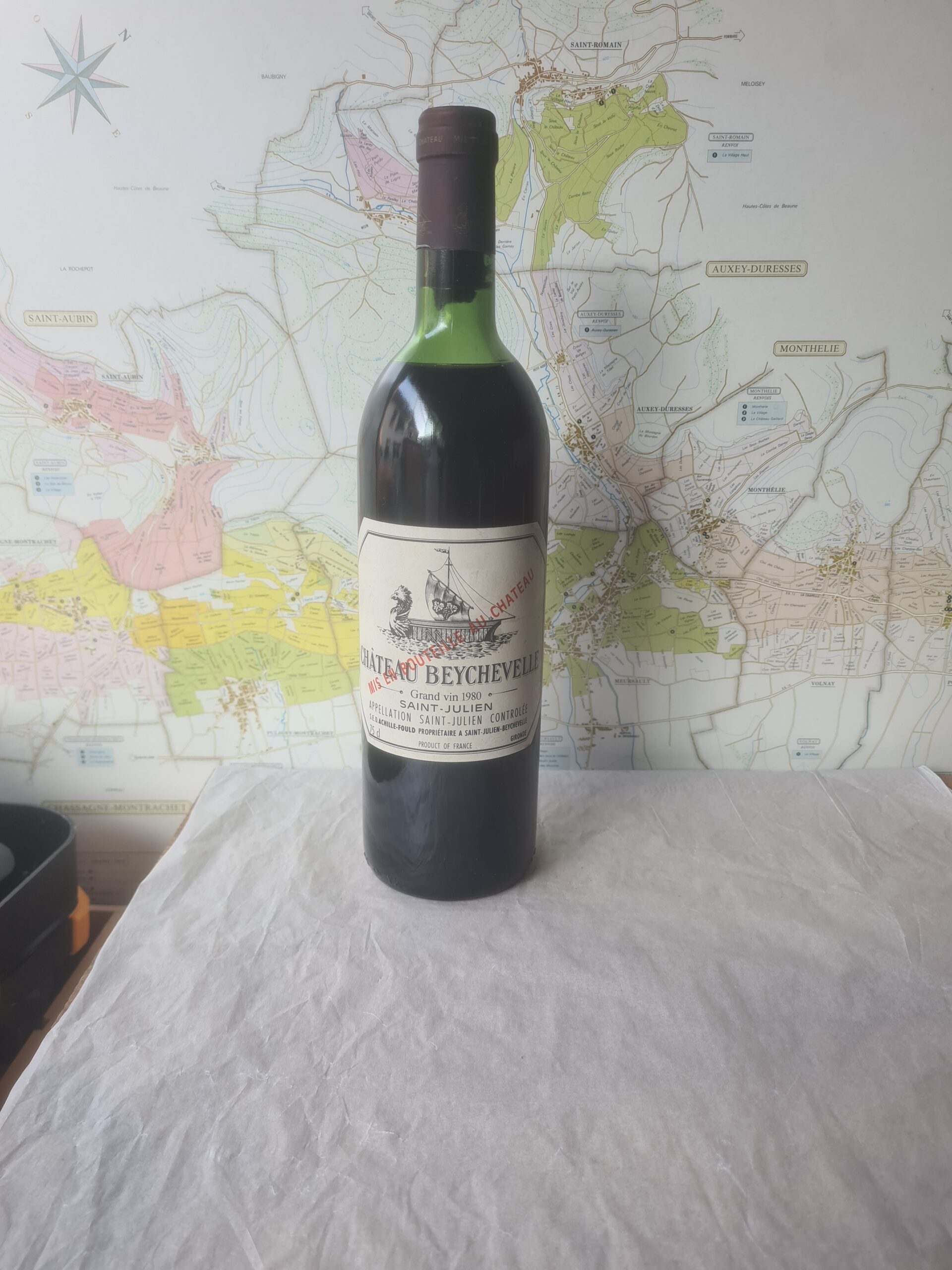
Château Beychevelle Saint Julien Grand Cru Classe 1980
Château Beychevelle, met het opvallende etiket van het schip met griffioenboog. Dit danken zij aan de tijd toen de eerste hertog van Épernon eigenaar van het château werd. Wanneer de boten in de zeventiende eeuw het domein passeerden, lieten zij als een teken van diep respect en trouw hun zeilen zakken. Beychevelle is een afgeleide van de Gascon-naam Bêcha vêla wat ‘het laten zakken van de zeilen’ betekent.
Beychevelle wordt ook wel het Versailles van de Médoc genoemd vanwege het prachtige kasteel en de schitterende tuinen die op het landgoed te vinden zijn. In totaal omvat dit landgoed 250 hectare, waarvan 90 hectare aan wijngaarden. Het hart van de wijngaard ligt op twee grindplateaus van de Garonne, ontstaan in het Güntz-tijdperk: een perfect terroir voor de cabernet sauvignon. Hun wijngaarden bestaan voor 52% uit cabernet sauvignon, 40% merlot, 5% cabernet franc en 3% petit verdot.
De meest recente verbouwing van Château Beychevelle zorgt ervoor dat er een perfecte harmonie is ontstaan tussen wijngaard en kelder waardoor het terroir tot optimale expressie komt. Er worden hierdoor veel meer complexiteit en diepte onthuld in de wijn. Hier wordt innovatie en traditie perfect gecombineerd.
Tegenwoordig behoort Château Beychevelle tot Grands Millésimes de France, wat eigendom is van de groepen Castel en Suntory, en wordt het vertegenwoordigd door de heer Nobuhiro TORII. De draak op de boeg van het zeilschip is voor veel Aziatische wijnliefhebbers een extra stimulans voor aankoop. Een 4e Grand Cru Classé van formaat.
Wijnen
€99,00 incl. btw
Slechts 1 resterend op voorraad
Château Beychevelle Saint Julien Grand Cru Classe 1980
Château Beychevelle is een 4 ieme grand cru classe (classificatie van Médoc-wijnen van 1855) van de appellatie Saint-Julien. Gelegen op de linkeroever van de Médoc, omvat de wijngaard 92 hectare aan wijnstokken. De wijnstokken zijn ongeveer 30 jaar oud en profiteren van een beredeneerde behandeling. Château Beychevelle is een klassieke Saint-Julien: rondheid, rijke aroma’s en kracht. De klassieke harmonie van de grootste Médoc, die veel meer verdient dan de vierde cru van de classificatie van 1855.
Chateau Beychevelle wordt door zijn fans, vanwege de klassieke, verbluffende architectuur van het kasteel en de prachtige tuinen, vaak de Bordeaux-versie van Versailles genoemd. De geschiedenis van Beychevelle gaat echter veel verder terug.
Om de macht van de hertog te begrijpen, is het belangrijk om op te merken dat alle schepen die voor Beychevelle voeren, de opdracht kregen om hun zeilen te strijken als teken van respect. Dat is in feite waar Beychevelle zijn naam aan ontleent.
Chateau Beychevelle, vertaald uit het dialect van die tijd, dat Baisse Voile was, betekent ‘laat de zeilen zakken’. Deze gebeurtenis is de inspiratie voor hun labelontwerp en wordt geëerd met het beeld van de boot in de tuin, aan de achterkant van het kasteel.
Beychevelle werd verkocht en opnieuw verkocht aan een groot aantal mensen. Vanwege de enorme kosten om het Saint Julien-landgoed up-to-date te houden, liet elke eigenaar Beychevelle verder afglijden naar verwaarlozing. Dit patroon veranderde in 1757 toen de markies François-Etienne de Brassier het hele landgoed renoveerde en herbouwde. Het kasteel dat in 1757 door de Brassier werd gebouwd, is nog steeds in gebruik.
In 1970 nam Aymar Achille-Fould het beheer van Chateau Beychevelle over. In 1984 nam Achille-Fould voor het eerst een partner aan toen hij een klein deel van de aandelen verkocht aan de GMF Insurance Group. Na het overlijden van Aymar Achille Fould in 1986, na 100 jaar familiebezit, werd GMF Insurance de meerderheidsaandeelhouder. In 1988 ging de GMF Group een partnerschap aan met het Japanse bedrijf Suntory.
The vines are planted to a density that ranges from 8,300 to 10,000 vines per hectare. Newer plantings are done at higher levels of vine density. On average, the vines are over 30 years of age. Starting in 2008, Chateau Beychevelle began moving closer to organic farming techniques. Today more than 35% of the vineyard is farmed organically. Progress is always slow and steady in Bordeaux, especially in the Medoc.
They also have vines in the southern tip of the St. Julien appellation as well as parcels located further inland, not far from Chateau Gruaud In all they have 14 different blocks of vines, that can be divided into almost 60 different parcels of vines.
That being said, their best vines, which number about 20 hectares are planted adjacent to the chateau on the Beychevelle plateau, next to Chateau Ducru Beaucaillou, with a view of the Gironde.
At its peak, the vineyard plateau rises up to 18 meters. However, it is also important to note that the estate also owns 22 hectares of vines that are actually located in the neighboring Haut Medoc appellation, in Cussaac that are considered part of the Saint Julien appellation.
The vines in the Haut Medoc are situated in the commune of Cussac, not far from Chateau Beaumont, which the estate also owns. There, you find a very different and much cooler terror than their vineyards in the St. Julien appellation.
Due to the fact that those vines were part of Chateau Beychevelle at the time of the original classification, even though they are located in the neighboring appellation of Haut Medoc, the estate has the right to include those vines in either their Grand Vin, the2nd wine or use them to produce an Haut Medoc wine.
Those parcels are planted mostly to Cabernet Sauvignon, although many of those vines are being replaced with Merlot. Chateau Beychevelle also owns an additional 14 hectares of vines in the Haut Medoc, that are not allowed for use in St. Julien.
Today, close to 35% of their vineyards are farmed using organic vineyard management techniques. Previously, the percentage was higher, but that has recently changed. It is the definitive direction of Beychevelle to continue increasing the number of hectares in their vineyards that are farmed organically.
However, while the estate continues to expand its organic farming, they also believe in being green, sustainable, and energy efficient. All the waste created by the estate is not placed back into the environment.
In fact, newly planted bushes, plants, and assorted greenery were recently added to the grounds to help promote biodiversity. This, coupled with their sustainable farming practices, earned them the ISO 14001 certification.
Making the Wine of Chateau Beychevelle
The wine of Chateau Beychevelle is vinified in 59, gleaming new, troconic shaped, stainless steel vats that range in size from 73, 105, 120, and up to 160 hectoliters. Malolactic fermentation takes place in a combination of barrels and in tank.
However, depending on the vintage, a large portion of the malolactic, if not all of it can take place in the barrel. The wine of Chateau Beychevelle is aged in an average of 70% new, French oak barrels for about 18 months before bottling. While this is an increase in the amount of new oak than older vintages saw, this is clearly better for the aging of the wines as texturally, Beychevelle is now much silkier and creamier on the palate.
There is a second wine, Amiral de Beychevelle which made its debut in the 1950s. However in those days, perhaps only 4% of the wine was placed into the second wine. It was the decision of Philippe Blanc to vastly increase the percentage of the harvest placed into the second wine, in 1996. There is also a third wine, which is sold as a supermarket brand.
Chateau Beychevelle invested more than 20 million Euros to completely renovate its wine-making facilities with a major remodeling of its cellars, vat rooms, tanks, and visitor center. Designed by the noted architect Arnaud Boulain and Atelier BPM, the most striking feature of the new winery is its glass walls.
The glass walls enclosing the cellars are unique in Bordeaux, allowing visitors to instantly peer directly into the winery and view the winemaking taking place. The construction was finished in 2016. Now that it’s completed, visitors can see the estate from Route de Medoc.
Clearly, the biggest improvement in the quality of the wine being produced at Chateau Beychevelle is due to the massive reduction in the effective yields at the property. Vintages like 1982 were produced with almost no selection. In fact, close to 95% of the harvest was placed into the Grand Vin in 1982.
Now, the average amount of the harvest going into Beychevelle is closer to 50%! Today, on average, the production of Chateau Beychevelle is about 25,000 cases per year.
The best vintages of Chateau Beychevelle are: 2023, 2022, 2021, 2020, 2019, 2018, 2017, 2016, 2015, 2014, 2012, 2010, 2009, 2005, 2000, 1989, 1982, and 1961. However, other older vintages of Chateau Beychevelle, dating back to 1906 have been fabulous wines! If you see these wines at auction, they are worth considering, especially if they have good provenance.
| Gewicht | 2 kg |
|---|---|
| Land | Frankrijk |
| Regio | Saint Julien |
| Jaar | 1980 |
Maak een account bij ons aan en blijf op de hoogte van onze nieuwste aanwinsten. Plus 10% korting op je eerste bestelling!
Bevestig dat u 18 jaar of ouder bent om toegang te krijgen tot deze website.